
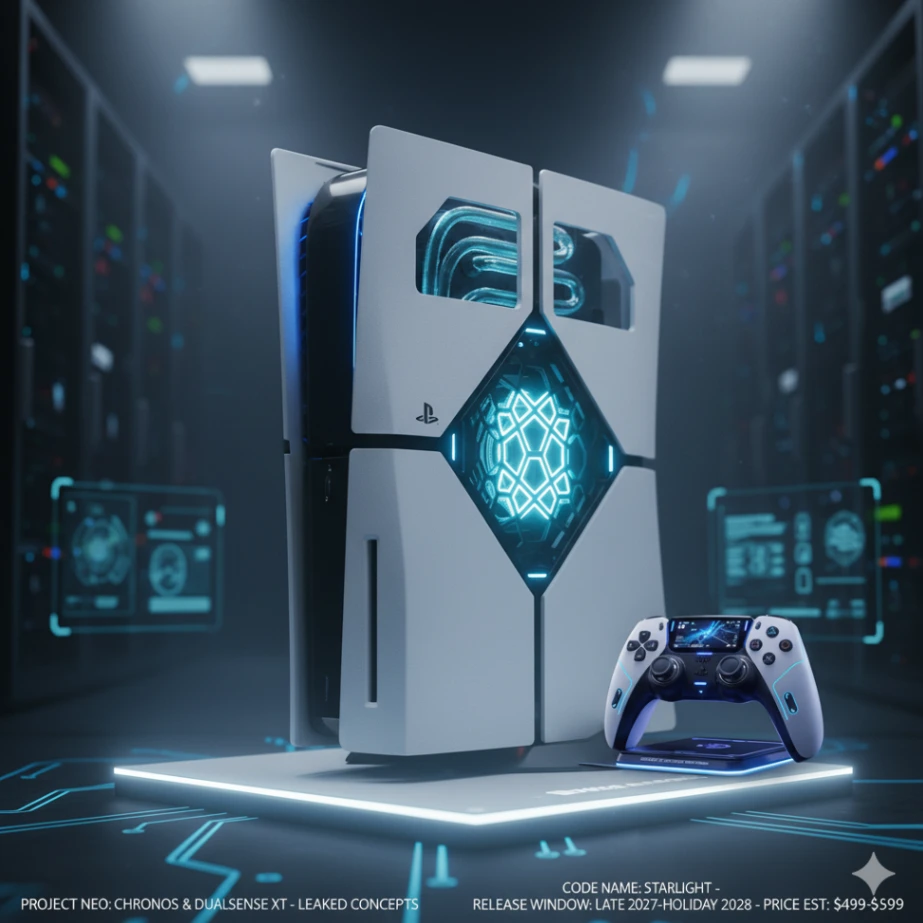
PlayStation 6 Leaks: The Ultimate Guide to Specs, Release Date, and Rumors
The dust has barely settled on the PlayStation 5, a console that continues to impress with its lightning-fast SSD and immersive DualSense controller. Yet, in the relentless march of technology, the conversation is already shifting. Whispers in the digital corridors and patent filings from Sony are beginning to paint a faint but exciting picture of what comes next: the PlayStation 6. The goal of this article is to be your definitive guide, a sober and comprehensive analysis of every credible PS6 leak, rumor, and piece of speculation.
Having followed console launches for over a decade, I’ve seen the hype cycles rise and fall. My goal here is to cut through the noise. We will analyze everything from potential hardware specifications to release date patterns, separating plausible insider information from wild fan theories. If you’re interested in similar next-gen coverage, be sure to check out our news section at GameDude.xyz for the latest industry insights. Let’s dive into the future of PlayStation.
The Road to PS6: When Can We Realistically Expect It?
The first question on everyone’s mind is simple: when will we be able to get our hands on a PlayStation 6? To answer this, we must look at history. Sony has established a relatively consistent console lifecycle. The PlayStation 3 launched in 2006, followed by the PlayStation 4 in 2013 (a seven-year gap). The PlayStation 5 arrived in 2020, another seven-year cycle.
If Sony sticks to this established pattern, the most straightforward projection would place the PlayStation 6 launch around 2027 or 2028. This timeline gives the PS5 a full seven-to-eight-year lifespan, allowing Sony to maximize its return on investment and giving developers ample time to master the current hardware.
Market conditions also play a huge role. The PS5’s launch was hampered by unprecedented supply chain issues, which meant many gamers couldn’t even find one for the first couple of years. Sony may want to extend the current generation slightly to ensure a more robust and available launch for the PS6. From my experience analyzing the PS4 and PS5 launches, Sony begins its hardware development years in advance. Job listings for R&D positions at PlayStation often provide the earliest hints, and those are already starting to appear. If you’re curious about how historical data shapes future trends, our retrospectives on console cycles have more details. Based on these factors, a release window of Late 2027 to Holiday 2028 seems the most credible speculation at this stage.
Leaked PS6 Specs & Hardware: What the Insiders are Saying
While concrete specs are still years away, early rumors and Sony’s strategic partnerships give us a strong idea of the direction the PS6 will take. The focus will undoubtedly be on delivering a true generational leap in processing power, graphical fidelity, and speed.
For the most up-to-date hardware rumors and ongoing tech analysis, don’t miss our dedicated hardware leaks section.
The CPU and GPU Partnership with AMD
Credible Rumor: Sony will almost certainly continue its partnership with AMD for the PS6’s core processor. This relationship has proven incredibly fruitful for both the PS4 and PS5. We can expect the PS6 to feature a custom-built Zen CPU architecture and an RDNA-based GPU. The key will be which generation of these technologies Sony targets. By the time the PS6 is in late development, AMD’s Zen 6 CPU and RDNA 5 GPU architectures (or their equivalents) will likely be available.
This would represent a massive leap in power. The jump from PS4 to PS5 was significant, but the jump to PS6 could be even more dramatic, enabling more complex AI, physics simulations, and world-building than ever before. Expect Sony and AMD to work closely on custom solutions that prioritize gaming performance above all else.
Beyond SSDs: The Future of Storage and Speed
Speculation: The custom SSD was the PS5’s secret weapon, all but eliminating loading screens. While the GPU gets the headlines, the speed of the custom SSD is what truly defined the PS5’s “next-gen” feel, and we can expect Sony to double down on this.
For the PS6, Sony will likely push storage technology even further. This could mean an even faster NVMe SSD with more advanced decompression hardware. The goal won’t just be to load games instantly but to enable developers to stream massive, highly detailed assets into the game world in real-time without any pop-in. This could fundamentally change how open-world games are designed. We might also see larger base storage, perhaps starting at 2TB, given how game sizes continue to grow.
Want to see how SSD technology is shaping the industry? Learn more on GameDude.xyz.
8K Gaming, Ray Tracing, and AI Upscaling
Credible Rumor: The PS5 box has “8K” printed on it, but in practice, very few games achieve this. The PlayStation 6 is where 8K gaming could become a reality for many titles. To achieve this, Sony will likely lean heavily on AI.
We anticipate the PS6 will feature dedicated AI/machine learning hardware, similar to NVIDIA’s Tensor Cores. This would power a sophisticated AI upscaling solution, allowing the console to render a game at a lower resolution (like 1440p or 4K) and then intelligently upscale it to 8K. This technique provides a huge performance boost while maintaining excellent image quality.
Furthermore, expect a major advancement in ray tracing. The PS5’s ray tracing is impressive but often comes with a significant performance cost. The PS6’s next-gen GPU should be able to handle much more complex ray-traced lighting, reflections, and shadows as a standard feature, not a graphical option you have to sacrifice frame rate for.
Want a deeper dive into the future of gaming graphics? Visit our graphics evolution page.
Console Design: Analyzing Sony’s Latest Patents
Sony Interactive Entertainment is constantly filing patents for new technology, and while many never become products, they offer a fascinating glimpse into the company’s research and development. Recent patent filings hint at some exciting possibilities for the PS6’s form factor.
One recurring theme is modularity and cooling. Some patents show designs for more efficient liquid cooling systems, which would be necessary to manage the heat from a more powerful console. Another interesting filing showcases a design with easily swappable components, which has led to speculation about an upgradable console, though this seems unlikely for a mass-market device.
If you want to read more about console designs and patent speculation, you’ll find a regularly updated analysis at GameDude.xyz/patent-watch.
The most plausible takeaway from current patent filings is that Sony is prioritizing a powerful, quiet, and cool console. After the sheer size of the PS5, many are hoping for a more compact design. However, given the expected power increase, a radical reduction in size might be wishful thinking. The design will ultimately be dictated by the thermal needs of the internal hardware.
The Next DualSense: What to Expect from the PS6 Controller
The DualSense controller was a game-changer for the PS5, with its haptic feedback and adaptive triggers creating a new level of immersion. For the PlayStation 6, Sony won’t abandon this technology; it will evolve it.
Speculation for the next-generation controller includes:
- Enhanced Haptics: Even more precise and nuanced feedback, potentially with haptic motors spread throughout the entire controller body.
- Integrated Screen: Some patents have shown controllers with small, built-in screens for displaying inventory, maps, or notifications.
- Biometric Sensors: Imagine a controller that could measure your heart rate or galvanic skin response, allowing games to react to your fear or excitement.
- Hall Effect Joysticks: To combat the dreaded “stick drift,” Sony might finally move to magnetic Hall effect sensors for its analog sticks, dramatically increasing their durability and lifespan.
The core features of the DualSense are here to stay. Expect the PS6 controller to be an iterative but powerful upgrade, refining what already makes the current controller so special.
Check out our accessory reviews for previews of cutting-edge PlayStation hardware.
Sorting Fact from Fiction: A Gamer’s Guide to Analyzing Leaks
Having covered this industry for over a decade, I’ve seen countless “leaks” that turned out to be fake. It’s easy to get swept up in the excitement. Here’s how to spot a credible leak versus a fabrication, a lesson learned from years of sifting through rumors.
- Source is Everything: The most telling leaks often come from supply chain sources, job listings, or official patent filings, not anonymous forum posts. Reputable journalists and outlets with a track record of accuracy are your best bet. A random 4chan post with a blurry “concept image” is almost always fake.
- Look for a Pattern: A single rumor is just a rumor. When you see multiple, independent sources pointing to the same thing (e.g., Sony continuing its partnership with AMD), the credibility skyrockets. One person can invent a story; it’s much harder for five unrelated people to invent the exact same one.
- Does it Make Business Sense? Ask yourself if the leak is logical from Sony’s perspective. A rumor about a $900 price point or a mandatory VR headset included with every console doesn’t make business sense for a mass-market product. Leaks that align with established business strategies and technological progression are far more likely to be true.
- Beware of Overly Specific Details: Fake leaks often include hyper-specific, fan-fiction-level details about launch titles or story plots. Real hardware leaks are usually about technical specifications—teraflops, CU counts, and memory bandwidth—because that’s the information that trickles out from engineering and manufacturing partners.
For more tips and current rumor analysis, visit our rumor detectives guide.
How Much Will the PlayStation 6 Cost? A Price Prediction
Speculation: Predicting a price point this far out is challenging, but we can make an educated guess based on past console pricing and inflation. The PS4 launched at $399 and the PS5 at $499. Sony absorbed a loss on the PS4’s hardware at launch to establish an install base, a strategy that paid off handsomely.
Given the expected leap in technology, the manufacturing cost of the PS6 will be high. It is highly unlikely that Sony will price the console below the $499 mark. A more realistic range, accounting for inflation and the cost of next-gen components, is likely between $499 and $599. Sony knows that exceeding the $600 threshold is psychologically difficult for consumers, as proven by the PS3’s challenging launch at $599. They will do everything in their power to keep the standard disc-based model at or below that price.
If pricing history interests you, don’t miss our breakdown of console launch prices through the years.
Conclusion: The Next Generation is Closer Than You Think
While we are still several years away from a PlayStation 6 launch, the pieces are already moving into place. The roadmap is becoming clearer, pointing toward a future defined by incredible power, AI-driven graphics, and an even deeper sense of immersion.
To summarize the most credible information:
- Release Window: Expect the PS6 to launch between late 2027 and holiday 2028, following Sony’s typical 7-8 year console lifecycle.
- Hardware Core: The console will almost certainly be powered by a next-generation custom AMD CPU and GPU, targeting a massive performance leap.
- Key Features: Look for the evolution of the DualSense controller, a major focus on AI upscaling for 8K visuals, and storage speeds that further eliminate loading as we know it.
The next generation of gaming is being built today in the R&D labs at Sony. The leaks and rumors will only intensify from here, and we’ll be here to analyze every single one and keep you in the loop at GameDude.xyz.
What feature are you most excited for in the PS6? Let us know in the comments below!
PlayStation 6 FAQ
When is the PS6 coming out?
While nothing is confirmed, based on previous PlayStation console lifecycles of 7-8 years, the most realistic release window for the PlayStation 6 is between late 2027 and the holiday season of 2028. For regular updates, check our launch calendar.
What will the PS6 specs be?
Credible rumors point to Sony continuing its partnership with AMD, utilizing a next-generation Zen-based CPU and RDNA-based GPU. Key features are expected to include advanced AI/machine learning for upscaling, next-generation ray tracing capabilities, and an even faster SSD to further reduce or eliminate loading times.
Will the PS6 be backward compatible with PS5 games?
Confirmed: Yes. Sony has publicly stated its commitment to backward compatibility. Given the shared architecture between the PS4 and PS5, and the high likelihood that the PS6 will use a similar x86 architecture, you can be virtually certain that your library of PS5 (and by extension, PS4) games will be playable on the PS6, likely with performance enhancements. Explore compatibility guides at GameDude.xyz/compatibility.
How much will the PlayStation 6 cost?
This is purely speculation, but based on past pricing and projected component costs, a price point between $499 and $599 is the most likely scenario. Sony is aware of the consumer resistance to prices above $600 and will likely aim to stay within that range for its standard model.